THE SHORT ANSWER
Creatine monohydrate is the form behind almost all of the research on strength, power and safety. Creatine HCl dissolves more easily and is often sold in smaller doses, but there is little to no evidence that it, or any other newer form, works better or is safer than monohydrate. For most athletes, plain monohydrate at 3 to 5 g a day is the simplest and cheapest choice.
KEY TAKEAWAYS
- Monohydrate is the most studied form by a wide margin.
- A 2011 review found little to no evidence that newer forms beat monohydrate.
- Smaller HCl doses are a marketing point, not proof of better results.
- Read the label: the form and the milligrams of creatine should both be listed.
Why there are so many forms of creatine
Creatine monohydrate has been sold since the early 1990s, and it is cheap to make. That is a problem if you want to charge more for creatine. So brands keep releasing new versions: hydrochloride (HCl), buffered creatine, creatine ethyl ester, creatine nitrate, creatine malate and more. Each one comes with a pitch about better absorption, less bloating or a smaller dose.
Those claims are easy to print and hard to prove. To prove a form is better, you would need trials that compare it head to head with monohydrate on muscle creatine levels, strength and body composition. For most newer forms, those trials are thin or missing.
What monohydrate has going for it
A 2011 review in Amino Acids looked at the efficacy, safety and regulatory status of the newer forms. Its summary of monohydrate is blunt: supplementation raises muscle creatine and phosphocreatine by roughly 15 to 40%, it is not broken down during normal digestion, and nearly 99% of what you swallow is either taken up by muscle or excreted in urine. In other words, absorption is not the weak spot that newer forms claim to fix.
The same review found little to no evidence that any newer form is more effective or safer than monohydrate, alone or combined with other nutrients. The ISSN position stand and its 2021 review of common creatine questions reach the same place: monohydrate remains the reference form.
Creatine HCl: the honest version
Creatine HCl is creatine bound to hydrochloric acid. It dissolves in water more easily than monohydrate, and that part is real. The jump from there to it working better at a fraction of the dose is the part that lacks strong evidence. A smaller scoop of HCl also delivers less creatine, so compare the milligrams of actual creatine, not the scoop size.
If monohydrate upsets your stomach, splitting the dose into two smaller servings with meals is usually the first fix to try. Some people still prefer HCl for how it mixes. That is a fair personal choice, as long as you know you are paying for convenience, not for proven extra results.
| Form | Main claim | What the evidence says |
|---|---|---|
| Monohydrate | The original | Hundreds of studies on strength, power and safety |
| Hydrochloride (HCl) | Dissolves better, smaller dose | Better solubility; little evidence of better results |
| Buffered | Less breakdown in the stomach | Little evidence it beats monohydrate |
| Ethyl ester | Better absorption | Little evidence it beats monohydrate |
| Dicreatine malate | Creatine plus malic acid | Far less studied; often used inside pre-workouts |

Reading a creatine label like a buyer
A Supplement Facts panel should tell you the form and the amount per serving in milligrams. FDA labeling rules let brands group ingredients into a proprietary blend and list only the total weight of the blend, which means you cannot see how much creatine you are getting. If a creatine product hides its dose in a blend, you cannot compare it to anything.
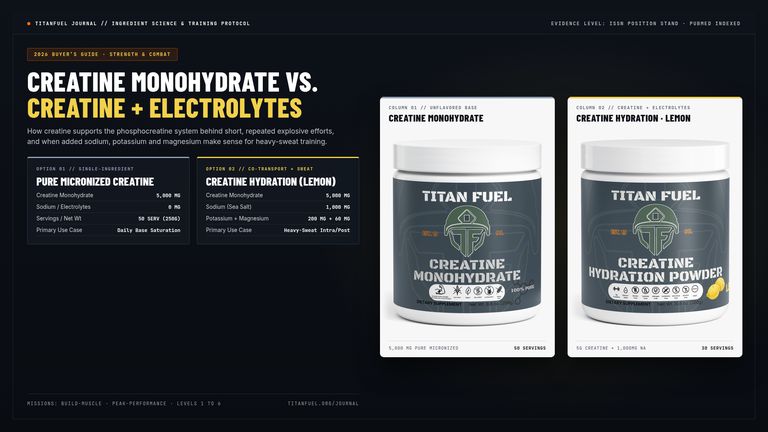
Our Creatine Monohydrate lists one line: creatine monohydrate, 5,000 mg. Our Creatine Hydration Powder (Lemon) lists the same 5,000 mg plus 1,000 mg of sodium, 200 mg of potassium and 60 mg of magnesium. Our Nitric Shock Pre-Workout uses a different form, 1,500 mg of dicreatine malate per scoop, alongside 175 mg of caffeine. To be straight with you, Nitric Shock also has a 550 mg energy, endurance and focus matrix whose individual amounts are not broken out, so it is not a replacement for a daily creatine dose.
For fighters, rucking crews and PT test prep
Combat athletes and service members often ask whether a fancy form means less water weight. Monohydrate can add about 2 to 4 lb (1 to 2 kg) of water inside muscle in the first weeks, mostly after a loading phase. There is no good evidence that HCl avoids this at an equal creatine dose. The practical fix is timing: skip the load and start a daily 3 to 5 g scoop at least a month before a weigh-in or body composition check.

MYTH OR FACT
Creatine form myths, checked
Tap a myth to see the facts.
MYTHMonohydrate is poorly absorbed.
FACTNearly 99% of ingested monohydrate is taken up by muscle or excreted in urine, according to a 2011 review.
MYTHHCl means no water weight.
FACTNo good evidence shows less water retention at an equal creatine dose.
MYTHA 750 mg HCl scoop equals 5 g of monohydrate.
FACTThat claim lacks solid head-to-head trials. Compare the actual milligrams of creatine.
Whichever form you pick, the routine is the same. One dose a day, every day, for at least four weeks, paired with real training. That is how athletes on our Build Muscle and Peak Performance missions get results.
FAQ
Is creatine HCl better than monohydrate?
There is little to no evidence that HCl is more effective or safer. It dissolves more easily, which some people like, but monohydrate has far more research behind it.
Does creatine HCl cause less bloating?
There is no strong evidence of less water retention at an equal creatine dose. Skipping the loading phase is the more reliable way to limit early scale weight.
What is the best form of creatine?
Creatine monohydrate is the most studied and usually the cheapest per gram. For most people it is the best place to start.
What is micronized creatine?
It is monohydrate milled into finer particles so it mixes more easily. The creatine itself is the same.
How do I know how much creatine is in a product?
Check the Supplement Facts panel for the form and milligrams per serving. If creatine is hidden inside a proprietary blend, you cannot see the dose.
IF YOU WANT A HAND
Fuel that fits this plan
Food and habits come first. If a supplement makes your routine easier, these are the ones that match this article.
SOURCES
- Jäger R et al. Analysis of the efficacy, safety, and regulatory status of novel forms of creatine (2011)
- Kreider RB et al. ISSN position stand: safety and efficacy of creatine supplementation in exercise, sport, and medicine (2017)
- Antonio J et al. Common questions and misconceptions about creatine supplementation (2021)
- FDA. Dietary Supplement Labeling Guide, Chapter IV: Nutrition labeling
This article is for general education and is not medical advice. Talk to your doctor before starting a supplement, especially if you have a health condition, take medication, are pregnant or are under 18. Results vary from person to person.