THE SHORT ANSWER
Creatine will not make your steady miles faster. A 2023 meta-analysis of 13 studies in trained athletes found no effect on endurance performance. Where it can help runners is the work around those miles: lifting, hill repeats, intervals and a finishing kick, plus glycogen storage when taken with carbs. If those matter to you, take 3 to 5 g a day and expect about 2 to 4 lb of water in muscle.
KEY TAKEAWAYS
- No clear effect on steady endurance in trained athletes, per a 2023 meta-analysis.
- Supports strength training, repeated sprints, hills and surges.*
- Taken with carbs, creatine raised glycogen storage after exhaustive exercise in a controlled study.
- Expect 2 to 4 lb (1 to 2 kg) of water in muscle, mostly if you load.
Why runners argue about creatine
Search creatine for runners and you will find two camps. One says it is a gym supplement that only adds weight you have to carry for 26.2 miles. The other says every athlete should take it. Both are partly right, and the useful answer depends on what kind of running you do and what else is in your week.
Creatine fills your muscles' store of phosphocreatine, a quick backup that rebuilds ATP in the first seconds of a hard effort. That is the energy behind a heavy squat, a 200 m repeat or a sprint to the finish line. Easy and steady running relies mostly on aerobic metabolism instead, which is why the results for distance runners look so different from the results for lifters.

What the research says about creatine and endurance
The most direct answer comes from a 2023 meta-analysis in Sports Medicine. Researchers pooled 13 placebo-controlled studies of creatine monohydrate in trained athletes and found no meaningful change in endurance performance. The pooled effect was trivial and not statistically significant.
A 2023 narrative review in the Journal of the International Society of Sports Nutrition adds nuance. Its authors note that creatine raises phosphocreatine stores, helps buffer acid during hard efforts and, taken with carbohydrate, supports glycogen storage. Across studies, creatine increased time to exhaustion during high-intensity endurance work, while time trial results were mixed. They conclude it is most likely to help events with repeated surges or a sprint finish. The same review points out that the added body mass may cancel out benefits in weight-bearing sports like running. Several authors disclose industry ties, so read it as a well-argued case, not a final verdict.
On glycogen, a 2016 study had 14 men cycle to exhaustion, then eat a very high-carb diet with either 20 g of creatine a day or a placebo. Muscle glycogen was clearly higher in the creatine group after just one day of recovery, and it stayed higher. That was cycling, with a large dose, so it is a promising signal for marathoners rather than proof of faster race times.
Where creatine can help a runner
- Strength training. The ISSN position stand calls creatine monohydrate the most effective nutritional supplement available for increasing high-intensity exercise capacity and lean mass during training. If you lift twice a week to run stronger, creatine supports that work.*
- Intervals and hills. Repeated short, hard efforts are where creatine research is strongest.
- The finishing kick. 5K and 10K races often come down to the last 400 m.
- Glycogen. Paired with carbs, it may help you store more muscle fuel, based on early research.
- Female runners. A 2021 review in women found benefits for strength and exercise performance, especially with resistance training.
- Vegetarian and vegan runners. Meat and fish are the main food sources of creatine, so plant-based runners tend to start with lower stores and often see a bigger rise when they supplement.
The scale question for distance runners
Creatine pulls water into muscle. Most people gain about 2 to 4 lb (1 to 2 kg) in the first weeks, mostly after a loading phase. For a 150 lb runner, 2 lb is about 1.3% of body weight. Whether that matters depends on your event and how you feel carrying it. Running data helps here: in one study of trained endurance runners, about 2 lb (0.9 kg) of extra body water from a creatine and glycerol mix did not change the oxygen cost of running. The good news: a 2009 systematic review found that creatine does not hurt heat tolerance or hydration status at recommended doses, and the 2021 ISSN review of common creatine questions does not support the claim that it causes cramping.
| Runner | Our take | Why |
|---|---|---|
| Beginner or couch to 5K | Optional | Consistency and easy miles matter far more right now |
| 5K and 10K racer who lifts | Worth a try | Strength, intervals and the final kick |
| Half or full marathoner | Optional, start early | Little direct benefit; test the water weight in training first |
| Trail and ultra runner | Situational | Climbs and power hiking reward strength, but every pound gets carried |
| Runners over 40 | Worth considering with lifting | Research in older adults pairs it with resistance training |

Side effects runners ask about
The most common effects are a little water weight and, for some people, an upset stomach or bloating, mostly during loading. Skip loading, take it with a meal and split the dose into two smaller servings if your stomach complains. The 2021 ISSN review of common questions found that creatine does not harm healthy kidneys at recommended doses, and the hair-loss claim rests on one small study that has not been repeated. If you have a kidney condition or take medication, talk to your doctor first.
How runners should take creatine
The ISSN position stand describes two routes. The fast route is a loading phase of about 0.3 g per kg of body weight a day (0.14 g per lb), usually split into four doses for 5 to 7 days, then 3 to 5 g a day. The slow route is 3 to 5 g a day from the start, which fills your stores in about three to four weeks. For runners, we recommend the slow route with plain creatine monohydrate. It keeps the early water gain smaller and is gentler on your stomach before runs.

Take it at a time you will remember every day, ideally with a meal. If you are in a marathon build, start at least 6 weeks before race day so you know how you feel at full stores, or wait until after the race. Do not start creatine for the first time during taper.
How to pick a creatine
- Creatine monohydrate. It is the form used in almost all of the research.
- A clear dose. Look for 3 to 5 g of creatine per serving, listed in grams, with no proprietary blend.
- Few extras. One ingredient is easiest to dose and to fit around race-day fuel.
INTERACTIVE
Creatine dose calculator
Daily dose, plus an optional loading phase.
Based on the ISSN position stand (Kreider 2017). Loading is optional; 3 to 5 g a day reaches the same levels in about 3 to 4 weeks. Follow your product label.
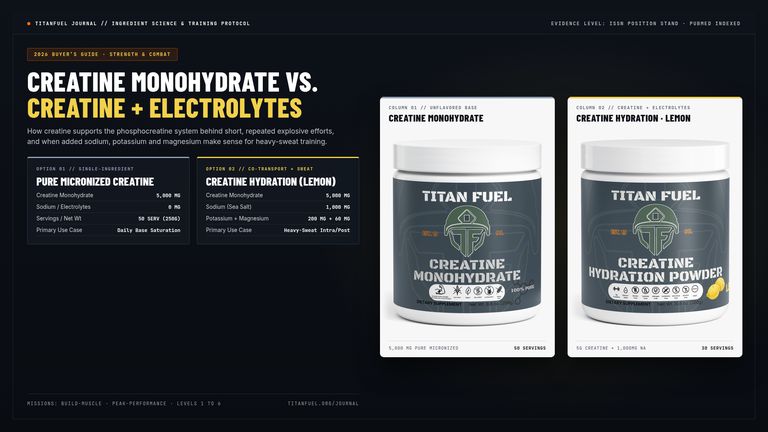
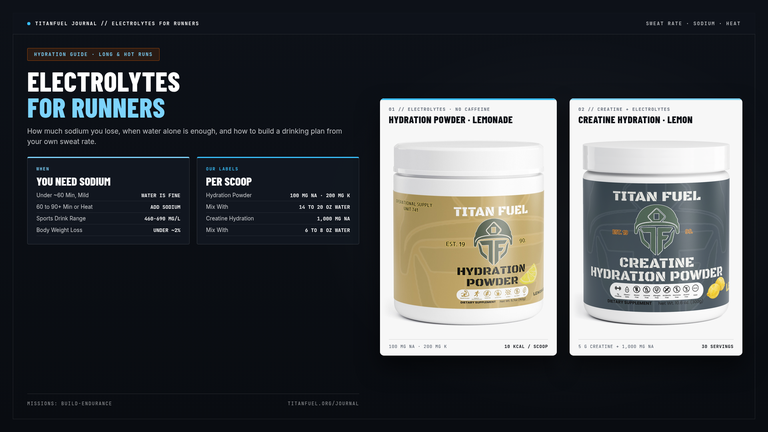
On hot days, our Creatine Hydration Powder (Lemon) gives you the same 5 g of creatine plus 1,000 mg of sodium, 200 mg of potassium and 60 mg of magnesium. Use it instead of your plain scoop, not on top of it, and only one scoop a day. Want the full comparison? Read creatine monohydrate vs. creatine with electrolytes.
MYTH OR FACT
Creatine myths runners hear, checked
Tap a myth to see the facts.
MYTHCreatine will make me slow.
FACTMost runners gain 2 to 4 lb of water in muscle. Whether that matters depends on your event, so test it in training.
MYTHCreatine dehydrates you in the heat.
FACTA 2009 systematic review found no harm to heat tolerance or hydration status at recommended doses.
MYTHCreatine only works if you load.
FACTThree to 5 g a day reaches the same muscle stores in about three to four weeks.
Is creatine right for my running?
0/4For the bigger picture, see our complete guide to supplements for runners, and for race day, how to fuel for a marathon. Building mileage? Start the Build Endurance mission. If speed work is your focus, the Peak Performance mission pairs well with a daily creatine habit. Lifting and running in the same week? The Daily Performance and Electrolyte Stack pairs Creatine Monohydrate with Hydration Powder; find it on the shop page. Making weight for a fight instead? See creatine for combat athletes.
FAQ
Is creatine good for runners?
It can be, depending on your training. It supports lifting, hill repeats and sprint finishes,* but a 2023 meta-analysis found no effect on endurance performance in trained athletes.
What are the side effects of creatine for runners?
Mostly 2 to 4 lb of water weight and, for some people, an upset stomach during loading. Skip loading, take it with food and split the dose. Research reviews have not found harm to healthy kidneys at recommended doses; talk to your doctor if you have a kidney condition.
Will creatine make me gain weight as a runner?
Most people gain about 2 to 4 lb (1 to 2 kg) of water stored in muscle, mostly with a loading phase. Taking 3 to 5 g a day without loading keeps the gain smaller and slower.
When should runners take creatine?
Any time you will remember daily, with a meal. Start at least 6 weeks before a goal race so you know how you feel, and never start during taper.
Should female runners take creatine?
Research in women shows benefits for strength and exercise performance, especially with resistance training. A daily 3 to 5 g dose works for most body sizes.
IF YOU WANT A HAND
Fuel that fits this plan
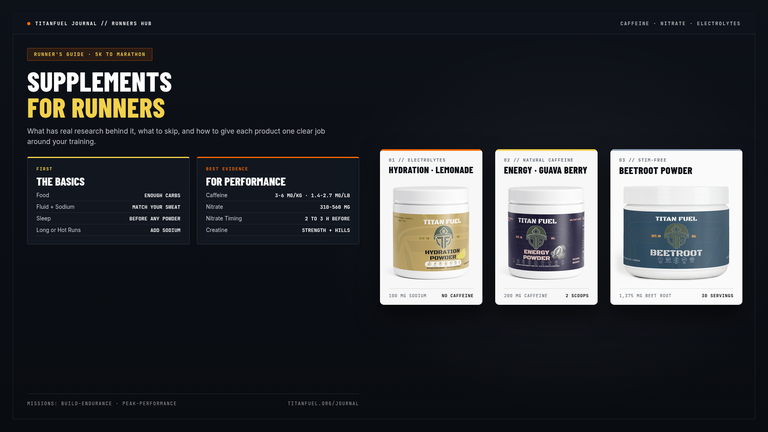
Food and habits come first. If a supplement makes your routine easier, these are the ones that match this article.
SOURCES
- Fernández-Landa J et al. Effects of creatine monohydrate on endurance performance in a trained population: a systematic review and meta-analysis (2023)
- Forbes SC et al. Creatine supplementation and endurance performance: surges and sprints to win the race (2023)
- Roberts PA et al. Creatine ingestion augments dietary carbohydrate mediated muscle glycogen supercompensation (2016)
- Kreider RB et al. ISSN position stand: safety and efficacy of creatine supplementation in exercise, sport, and medicine (2017)
- Antonio J et al. Common questions and misconceptions about creatine supplementation (2021)
- Lopez RM et al. Does creatine supplementation hinder exercise heat tolerance or hydration status? (2009)
- Smith-Ryan AE et al. Creatine supplementation in women's health: a lifespan perspective (2021)
- Beis LY et al. The effects of creatine and glycerol hyperhydration on running economy in well trained endurance runners (2011)
This article is for general education and is not medical advice. Talk to your doctor before starting a supplement, especially if you have a health condition, take medication, are pregnant or are under 18. Results vary from person to person.