THE SHORT ANSWER
Most runners need three things before any supplement: enough food (especially carbohydrate), enough fluid and sodium for their sweat, and enough sleep. After that, caffeine and dietary nitrate have the strongest research for running performance, creatine supports the strength and speed work around your runs, and magnesium, omega-3s and a multivitamin can fill gaps in a busy diet. Give each one a job, or skip it.
KEY TAKEAWAYS
- Food, fluid and sleep come first. Supplements fill gaps around them.
- Caffeine and nitrate have the best direct evidence for endurance performance.
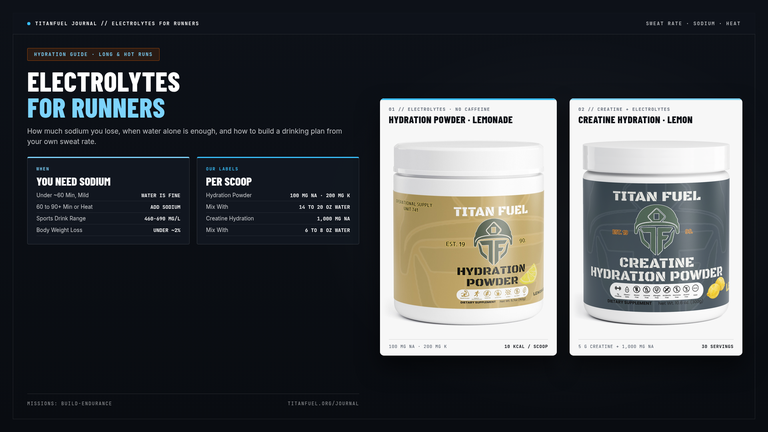
- Electrolytes matter most on runs past 60 to 90 minutes, in heat, or for salty sweaters.
- Creatine supports lifting, hills and finishing kicks more than steady miles.
What a supplement can and cannot do for a runner
Most runners do not need most of the powders, chews and tablets on a running store wall. The International Olympic Committee's consensus statement on supplements says supplements make a minor contribution to performance, and only a few, including caffeine, creatine, buffering agents and nitrate, have good evidence of direct benefits. Responses vary between people, so test anything you plan to use on race day.
A supplement earns a place in a runner's routine by doing one of three jobs: filling a gap your diet leaves, like sodium on a hot long run; supporting performance directly, like caffeine; or supporting the training behind performance, like creatine for strength work. If a product does none of those for you, save the money for shoes.

Running supplements ranked by evidence
| Supplement | Job for runners | Evidence for running | When it matters |
|---|---|---|---|
| Electrolytes (sodium first) | Replace what you sweat out | Strong for long and hot sessions | Runs past 60 to 90 minutes, heat, salty sweaters |
| Carbohydrate (drinks, gels, food) | Fuel for long and hard runs | Strong | Runs past about an hour, races |
| Caffeine | Helps you hold effort | Strong | Races and key workouts |
| Dietary nitrate (beetroot) | Lowers the oxygen cost of steady running in some people | Moderate; small or absent in highly trained runners | Daily in the days before key races |
| Creatine monohydrate | Supports lifting, hills and surges | Strong for strength; little effect on steady endurance | Daily, if you lift or race short |
| Protein | Supports muscle repair | Strong for recovery | After long runs and lifting |
| Magnesium, omega-3, multivitamin | Fill gaps in a busy diet | Depends on your diet | Daily, when food falls short |
Hydration and electrolytes: get this right first
The American College of Sports Medicine's fluid guidance aims to keep water losses under about 2% of body weight, because bigger deficits tend to hurt endurance performance, especially in heat. Sweat rates and sweat sodium vary a lot between runners, so the simplest accurate test is one you can do at home: weigh yourself before and after a run.
INTERACTIVE
Sweat rate calculator
Weigh in before and after a 1 hour session, add what you drank.
Body weight lost: 0.9%, under the 2% mark. Nice.
A practical drinking target: about 22 to 35 oz per hour, in small sips.
16 oz of sweat is about 1 lb of body weight. Urine during the session is ignored for simplicity.
Sodium is the electrolyte you lose most in sweat. On short, cool runs, water and normal meals cover it. On long or hot runs, add sodium. And if you finish a long run heavier than you started, you drank too much. Our full guide to electrolytes for runners walks through sodium per liter and hot-weather plans.
Carbohydrate: the supplement most runners underuse
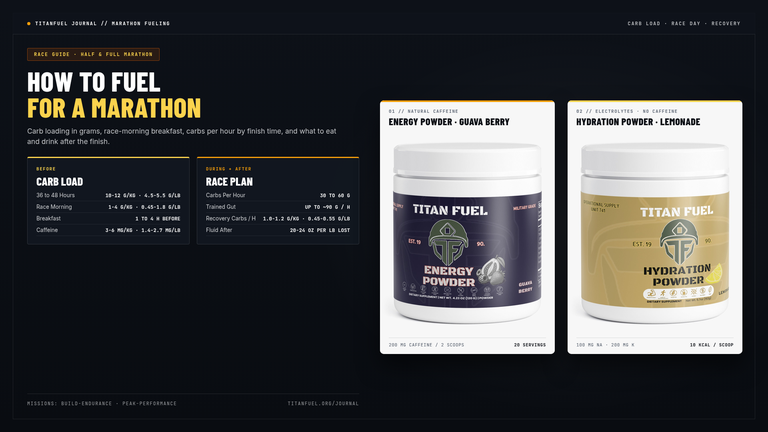
Carbs are the fuel that runs out first at marathon pace. Sports scientist Asker Jeukendrup's guidelines scale with time: up to about 30 g per hour for 1 to 2 hours, up to about 60 g per hour for 2 to 3 hours, and about 90 g per hour beyond that using mixed carb sources.
Daily intake matters too. The joint ACSM position statement suggests about 5 to 7 g of carbohydrate per kg of body weight a day (2.3 to 3.2 g per lb) for about an hour of training a day, and 6 to 10 g per kg (2.7 to 4.5 g per lb) for 1 to 3 hours a day. We do not sell gels; use whatever your stomach handles. Our marathon and half marathon fueling guide has a full race-week plan.
Caffeine: the best-studied performance aid
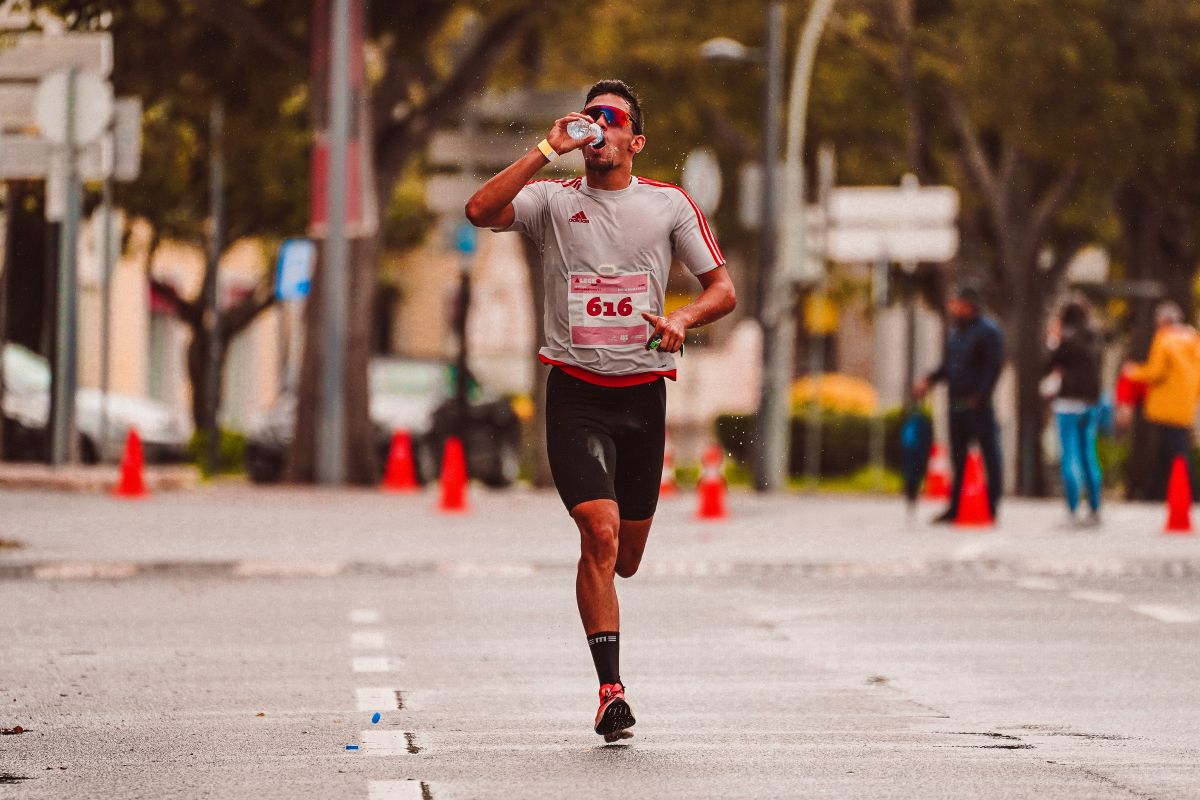
The ISSN position stand on caffeine found consistent benefits at 3 to 6 mg per kg of body weight (1.4 to 2.7 mg per lb). Aerobic endurance is where the evidence is strongest, usually with caffeine about 60 minutes before. For a 150 lb (68 kg) runner, 3 to 6 mg per kg works out to about 205 to 410 mg, and most people do well at the low end.
Our Energy Powder (Guava Berry) has 200 mg of natural caffeine from green tea per two-scoop serving, with 100 mg of L-theanine and 1,000 mg of taurine. One scoop is 100 mg. The FDA cites 400 mg a day as an amount not generally associated with negative effects in healthy adults, so count your coffee too.
Beetroot and creatine: useful, with fine print
Beetroot works through dietary nitrate. A 2020 meta-analysis of 80 studies found a small benefit in recreationally active young men and no effect on average in highly trained endurance athletes, mostly with concentrated beet juice taken 2 to 3 hours before exercise. Our Beetroot Powder does not list its nitrate content, so we do not sell it as a research-dose nitrate product. Read beetroot for running for the dose details.
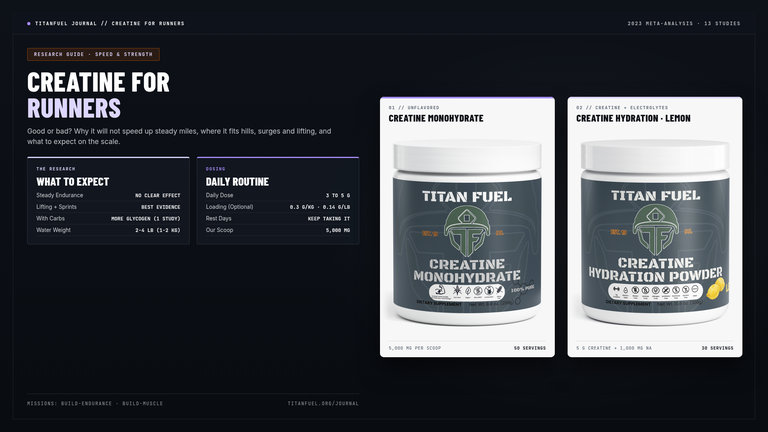
Creatine is the opposite story: a 2023 meta-analysis found no effect on endurance performance in trained athletes, but it supports surges, hills and finishing kicks, and adds about 2 to 4 lb (1 to 2 kg) of water in muscle. See creatine for runners.
Gap fillers: magnesium, omega-3, multivitamin, protein and iron
- Magnesium: a 2006 review notes that strenuous exercise increases magnesium losses and that marginal intake can affect performance. If you eat few nuts, seeds or beans, our Magnesium Glycinate gives you 275 mg of magnesium per three capsules. Magnesium supports normal muscle and nerve function.*
- Omega-3: if you rarely eat fatty fish, our Omega-3 gives you 180 mg of EPA and 120 mg of DHA per softgel. It fills a diet gap; it is not a performance product.
- Multivitamin: our Complete Multivitamin is a safety net for heavy training weeks. It does not list iron.
- Protein: about 0.3 g per kg (0.14 g per lb) after long runs and lifting, from food or a shake. Our whey isolate contains milk.
- Iron: low iron status is common in endurance athletes, especially women, according to a 2019 review. Ask your doctor for a blood test before you take iron. Do not guess with it.

QUICK QUIZ
Which supplement should you look at first?
Three quick questions about your running week.
MYTH OR FACT
Running supplement myths, checked
Tap a myth to see the facts.
MYTHRunners do not need creatine.
FACTIt does little for steady miles, but it supports lifting, hills and short, hard efforts that many runners train.
MYTHElectrolytes stop every muscle cramp.
FACTCramps have more than one cause, and fatigue plays a big part. Sodium replaces what you sweat; it is not a cramp switch.
MYTHMore water is always safer.
FACTDrinking far more than you sweat can lower blood sodium. Finishing heavier than you started is a warning sign.
My running supplement check
0/5Building toward a first half or full? Our Build Endurance mission and the TitanFuel training program give you the structure.
FAQ
What supplements should runners take?
Start with fluids and electrolytes for long or hot runs and carbohydrate during long runs. Caffeine and dietary nitrate have the strongest performance research. Creatine, protein, magnesium, omega-3 and a multivitamin can fill specific gaps.
What is the best supplement for running endurance?
Caffeine has the most consistent evidence, at 3 to 6 mg per kg (1.4 to 2.7 mg per lb) about an hour before. Nitrate from concentrated beet juice can help recreational runners, with smaller effects in highly trained athletes.
Should runners take creatine?
It depends on your training. A 2023 meta-analysis found no effect on endurance performance in trained athletes, but creatine supports lifting, hill repeats and sprint finishes. Expect about 2 to 4 lb of water weight.
Do runners need electrolytes?
For runs under an hour in mild weather, usually not. For runs past 60 to 90 minutes, hot weather or heavy sweating, add sodium to your fluids or eat salty food.
What helps runners recover after a long run?
Carbohydrate, about 0.3 g of protein per kg (0.14 g per lb), fluids with sodium, and sleep. Magnesium supports normal muscle function.*
IF YOU WANT A HAND
Fuel that fits this plan
Food and habits come first. If a supplement makes your routine easier, these are the ones that match this article.
SOURCES
- Maughan RJ et al. IOC consensus statement: dietary supplements and the high-performance athlete (2018)
- Thomas DT et al. ACSM joint position statement: Nutrition and athletic performance (2016)
- Sawka MN et al. American College of Sports Medicine position stand: Exercise and fluid replacement (2007)
- Baker LB. Sweating rate and sweat sodium concentration in athletes (2017)
- Jeukendrup A. A step towards personalized sports nutrition: carbohydrate intake during exercise (2014)
- Burke LM et al. Contemporary nutrition strategies to optimize performance in distance runners and race walkers (2019)
- Guest NS et al. ISSN position stand: caffeine and exercise performance (2021)
- FDA. Spilling the beans: how much caffeine is too much?
- Senefeld JW et al. Ergogenic effect of nitrate supplementation: a systematic review and meta-analysis (2020)
- Fernández-Landa J et al. Effects of creatine monohydrate on endurance performance in a trained population: a systematic review and meta-analysis (2023)
- Forbes SC et al. Creatine supplementation and endurance performance: surges and sprints to win the race (2023)
- Nielsen FH, Lukaski HC. Update on the relationship between magnesium and exercise (2006)
- Sim M et al. Iron considerations for the athlete: a narrative review (2019)
This article is for general education and is not medical advice. Talk to your doctor before starting a supplement, especially if you have a health condition, take medication, are pregnant or are under 18. Results vary from person to person.